“It is not enough to win a war; it is more important to organize the peace.”
— Aristotle
Beyond the surface, the 53IB follows the dictum of development, governance, and security efforts to defeat the communist insurgency in the province. The integration of intelligence operations, combat operations, and civil-military operations is like a dagger that crush the enemy’s heart. As the Army is trained for combat operations, they shall firmly deal with anyone who shall challenge the sovereignty of the government. They are made for the battlefield, but they have not won the war for long in fighting the CTG.
The 53IB strategy perfectly implements the hard-power and soft-power strategy involving active efforts to win the people’s hearts by building trust and gaining friendship while ferociously executing the art of warfighting. They put a premium on community engagement alongside combat operations. They persistently pursue the enemy with conviction to topple their ranks. Still, they encourage and exhaust efforts to convince them to surrender “…because we value the life of every person, including the life of the enemy,” declared Second Lieutenant Yu. Thus, the tactical gains in recent years may be significantly attributed to its maximized use of its nontraditional role in anti-insurgency efforts.
The primary threat to national security in the province is still the CPP-NPA. When Lieutenant Colonel Herrera assumed command of the 53IB, the CTG’s presence was still actively felt, especially in the remote hinterlands. Although the strength and influence of the CTG have dwindled after so many years of fighting, they were able to sustain their existence by the use of unconventional warfare quite effectively. They feed on public discontent and distrust toward the government and security forces. They fill the people’s lack of information with their twisted ideology. Dissatisfaction and lack of information supplied a prolific ground for enemy support. But between the two, the government’s inability to provide the basic needs and security of the people fueled the insurgency. There was very little ideological support, reaching only at the level of the CTG commanders.
The 53IB made intelligence and combat operations “the hard-power approach” and CMO and IO “the soft-power approach” work efficiently and effectively to complement each other. The latter is at the forefront of the whole strategy.” CMO everything that we do to win the hearts and minds of the people,” said Second Lieutenant Yu. It is the core of the whole 53IB strategy. They unearth and try to address the reasons for the dissatisfaction of the people in every community. They dissuade the negative perceptions, opinions, and attitudes that prevented them from bringing back the lost trust. Then they conquered the information landscape.
“The 53IB strategy perfectly implements the hard-power and soft-power strategy involving active efforts to win the people’s hearts by building trust and gaining friendship while ferociously executing the art of warfighting.” — Lieutenant Colonel Jo-ar A. Herrera
Cutting the Enemy’s Resources
“Every war in history was a contest of resources. We do not always need to go to battle, although we are trained for it. To win the war, we need to cut the enemies’ resources. When they decide to abandon the armed conflict peacefully, we accept and help them reintegrate into the society.”— BGen. Leonel M. Nicolas
For Brigadier General Leonel M. Nicolas, “Every war in history was a contest of resources. We do not always need to go to battle, although we are trained for it. To win the war, we need to cut the enemies’ resources. When they decide to abandon the armed conflict peacefully, we accept and help them reintegrate into the society.”
The battalion harnessed the full potential of mass base operations to gain the trust and support of the people and undermine the enemy’s pitiful gains. MBOs were conducted before, during, or after other military actions. It beneficially served the 53IB in many of its ends. An MBO was complementing along with different lines of operations to sustain the outcomes of the CSP in CTG stronghold communities. It was also mobilized to complement an ongoing FMO to deny support to the CTG and to constrict their maneuver space. More importantly, MBOs preempt and restrict recruitment by CTG members in vulnerable communities by securing and empowering the community.
Understanding the human factors affecting the operational environment is critical in holding the human terrain. CMO operatives in MBO teams intentionally engage tribal and sectorial leaders in the barangay, including the farmers, women, and youth organizations, to improve their relationships with the indigenous people. They conduct sectorial symposiums (pulong-pulong) with the residents to understand their predicaments and counter the enemy’s propaganda. They also establish mechanisms for direct coordination with the people.
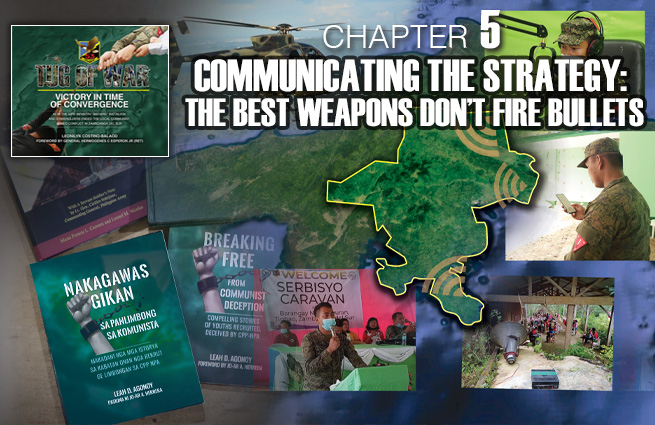
Public information is also a crucial component of an MBO. Correct information liberates the people from the deception of the CTG. A well-informed community is not easily misled or swayed. The MBO team distributes transistor radios in areas not covered by electricity. They also bring loudspeakers so they would be heard in the moors where the CTG might be listening. They speak in loudspeakers about the government’s offer and invitation for the CTG to lay down their arms and abandon their fight. They let CNTs who have surrendered speak about 53IB to help them return to their families and lead everyday lives. They entice their former comrades to surrender. They also distribute leaflets about the Enhanced Comprehensive Local Integration Program (E-CLIP) and amnesty programs for CNTs who will come back to the folds of the law. They lead flag-raising ceremonies in the barangays, in sitios, and purok to officially reestablish government control in the area.
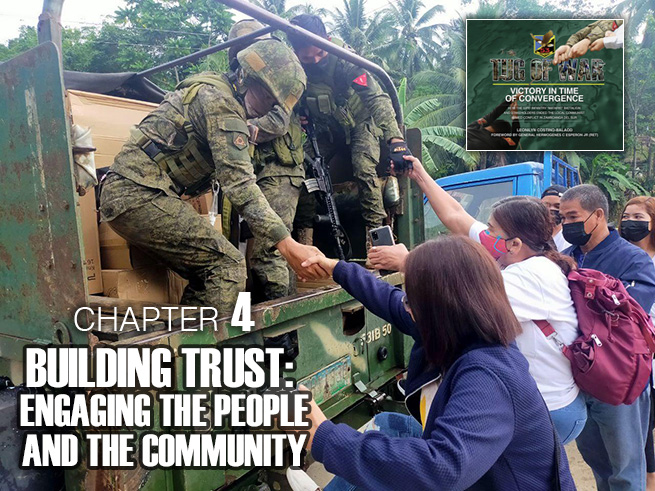
The MBO team also organizes medical outreach programs, community-based training, and Serbisyo Caravans. They befriended the children to remove their fear of the soldiers by giving toys, candies and managed feeding programs in lowly communities. These enabling activities are an essential component of CMO as it addresses the needs of the people in the community, which is primarily a driving factor of CTG support. The CMOs were conducted regularly in adjacent communities continuously eroded the support of the people to the enemy and drove them away to the province’s borders. It saved the battalion from going into virulent fire clashes, preserving the lives of the soldiers and civilians, their properties, and the stability in the community.
First Lieutenant Kimbongan with her team were actively involved in the CMO in support of the 53IB. “We were in Pagadian City to clear the radicalized student, youth, and teachers’ organizations from CTG influence. We were partners with the 53IB in all our activities,” she said.
First Lieutenant Kimbongan recalled, “We also had CMO operations in Dumingag for the sectoral organization of the IPs to complement the military operations in the area,” she continued. One of the best CMO activities of the 53IB was the launching of Oplan Amuma in Dumingag, ZDS. According to the lady officer, “Oplan Amuma is very commendable because the people initiate the activities and all sectors are involved and given attention. It greatly helped in their campaign’s success.”
Oplan Amuma is an initiative of the Local Government of Dumingag to end the insurgency in the municipality through reactivation and strengthening of people’s movement. It is the blueprint of the municipality’s unified approach in addressing the problem, which identifies the issues and concerns relating to the insurgency problem in the municipality. It also identified the activities, programs, and infrastructure projects for its first year of operation. The program was launched in August 2020 and will be continually updated to best serve the campaign’s needs. “The programs are funded, and responsible offices are identified to ensure that the agenda will be realized. We also have a focal person to supervise the overall campaign implementation,” Mayor Joan Pacalioga-Abejuela explained. “I am confident that our anti-insurgency efforts will be sustained through Oplan Amuma until our municipality becomes totally insurgency-free.”
The municipality borders the municipality of Osmeña in ZDN. It is the last town within the AO where the CTG presence is still occasionally seen. However, the mass support for the CTG has dramatically declined, according to Nacianceno M. Pacalioga, Jr., former mayor of the municipality. “For so long, the CTG lived in the remote communities of this municipality, so it would really take time to totally change the mindset of the people who were strongly influenced by the CPP-NPA,” he explained. He believes that the Oplan Amuma will eventually solve the issues that had fueled the people’s support to the CPP-NPA.
Gaining Peace by Building Trust
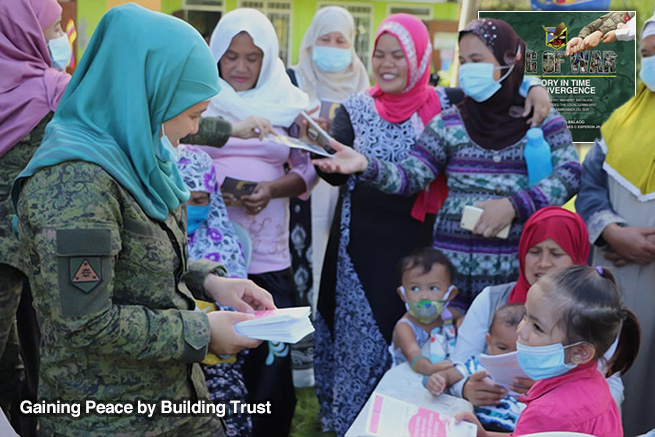
The 53IB assiduously made their presence felt in serving and taking care of the people. They actively organized local peace-building forums, where they invited municipal and barangay officials to 53IB Headquarters at Camp Sabido. Engaging barangay chairmen, “this forum brings up our united efforts on a shared responsibility toward peace and progress,” posited Second Lieutenant Yu.
The role of the barangay officials is very critical in the fight against insurgency. They are the frontline representatives of the government in their communities. They should be the first to understand the importance of peace to achieve progress and their power to bring it to their communities. Their solid support to the military efforts is an indispensable factor in winning the war against the CTG, the same way that their support to the enemy is detrimental to the cause of the Army.
For Governor Victor J. Yu, “Barangay officials are influential persons in their communities. They can convince the people to stop supporting the CTG and make them feel the sincerity of the government to end the armed conflict.” In his speech in one local peace-building forum, he encouraged the barangay officials to regularly profile their constituents and continue supporting the campaign against CPP-NPA.
Aside from the presence of the CTG, which is considered the main threat to security in the province, other criminal elements like the Ansang Group and private armed groups disturb the peace in coastal communities. These criminal groups are involved in drug trafficking, kidnapping for ransom, extortion, and sea piracy. They extort from small fisherfolks and fishpond operators. The 53IB engaged the Bangsamoro communities through Islamic symposiums to empower these communities and deter support to the lawless groups.
More communities may also be susceptible to violent extremism espoused by pro-ISIS local terrorist groups. Although these Islamic State-inspired groups do not exist in the province, their reputation and activities may attract local criminal groups. The 53IB continuously collaborates with Bangsamoro leaders to educate the people, especially the youth, to prevent and counter violent extremism.
To further the camaraderie with Bangsamoro communities, troops joined in several cultural and religious rights like the observance of Ramadan and took part in Iftar offerings. They launched Brigada Masjid and Madrasah projects to assist the Muslim communities in cleaning and repairing mosques to prepare for the Ramadan season. These initiatives are intended to show these communities that the government cares for them and weld the battalion’s closer ties with the Moro people.
Brigadier General Nicolas explained that “social issues which are left unaddressed can easily become security issues.” When the Army can establish a strong relationship with the people, it will be a two-way street. The Army can facilitate development in their communities. At the same time, the people will volunteer information about the activities of the CTG or other lawless groups which will make security administration in these places much easier for the Army.”
Whole-of-Nation Approach:
The Foundation of 53IB Strategy
Discontent, distrust, isolation, and lack of information provided fertile grounds for CTG influence in the hinterlands. Lack of infrastructure, basic needs, and services are among the issues raised during the first CSPs and MBOs. Many of these concerns cannot be addressed by the battalion. Therefore, it was imperative to invoke the participation of other agencies of the government, LGUs, non-government agencies, and other external stakeholders. It was essential to involve them in the strategy to end the insurgency.
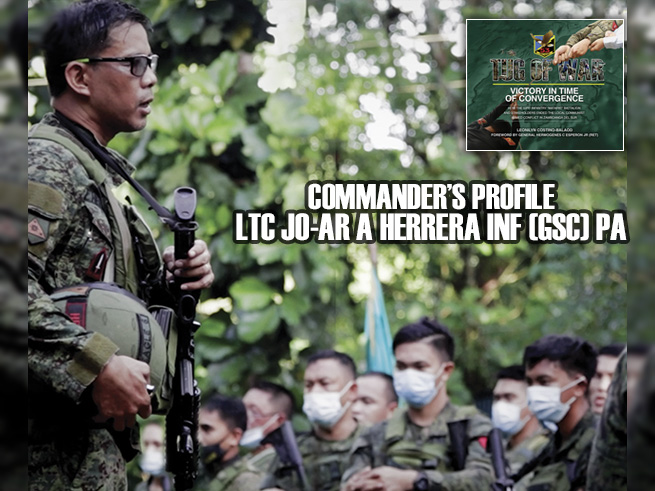
Leveraging on the mandate of EO 70, which mobilizes all government entities to the anti-insurgency campaign, the 53IB actively pursued these agencies to maximize their involvement and participation in accomplishing the mission of the battalion. Lieutenant Colonel Herrera established solid connections and cooperation with these agencies. He regularly meets, coordinates, and even propels them to action. He pushes critical projects and programs to local leaders.
The battalion played an active role in the delivery and implementation of ELCAC projects. They identify conflict-affected barangays, which are those they have cleared during their CSP, as target communities. ELCAC projects facilitate and contribute to developing a progressive environment by addressing the recurring issues exploited by the CTGs. Especially infrastructure projects such as the construction of farm-to-market roads (FMRs) disrupted the expansion of WMRPC. Road networks within and connecting municipalities and provinces significantly contribute to the collapse of WMRPC. It constricted the maneuver space of the CTG, making them vulnerable to government forces.
These communities become easily accessible by government services. The battalion monitors and inspects projects, especially in very distant barangays, and at the same time, ensures the safety of the agencies delivering services to these communities. “We are happy that finally, the government found the true solution to the insurgency problem. I have three barangays identified to receive the Barangay Development Program. I can feel that the people are excited about the projects that are coming to their community,” Mayor Domingo Mirrar of Lakewood, ZDS, said.
Regional Director Dan Navarro of Technical Education and Skills Development Authority (TESDA) – Region IX commends the aggressiveness of the battalion in the implementation of the programs of the Poverty Reduction, Livelihood, and Employment Cluster (PRLEC), in which he serves as the cluster chair. “I could feel the earnest intention and strong desire of Lieutenant Colonel Herrera to bring our programs to the people in very distant communities.” RD Navarro often visits and sleeps in these communities. He is not a bit concerned about his safety because to him, “Even if I would go alone or TESDA for that matter, I am sure that the Army is at my front and my back. We would not be there if not for their commitment to secure us.”
Life after Leaving the Armed Struggle
The combined intelligence operations, FMO, and CMO have dramatically increased the number of CNTs who laid down their arms and surrendered. The number was unprecedented, vouching for the effectiveness of their strategy. However, the work of the battalion did not end in their surrender. They are Friends Rescued (FRs), and they need to reintegrate and function in society successfully. Lieutenant Colonel Herrera wanted the FRs to live a good life,” said Sergeant Elvies D. Delos Reyes, lead NCO for the FRs. “If they are left out after they have surrendered, they will be back in the battlegrounds in no time,” he added. They function in intelligence collection and commando operations. Others, especially women and teens, were enrolled in 53IB’s Project Good Life.
Project Good Life
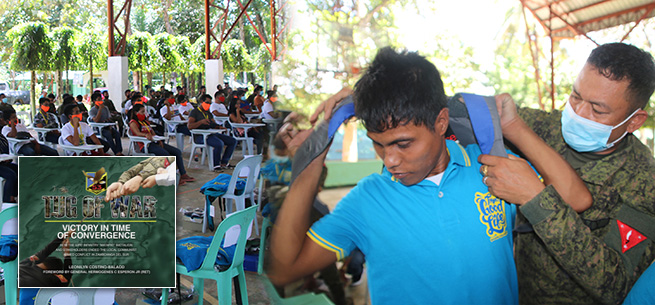
“If they are left out after they have surrendered, they will be back in the battlegrounds in no time.”
— Sgt. Elvies D. Delos Reyes
Project Good Life for Friends Rescued (FRs) is an inclusive wellbeing psycho-education program initiated by 53IB in partnership with various organizations and national government agencies. It aims to translate the initial strength-based research inquiry among former rebels of the 53IB to community extension service.
It is a need-based program for FRs to support EO 70 signed by President Rodrigo Roa Duterte, which institutionalizes the Whole-of-Nation approach to end local communist armed conflict in the country. The 53IB also partners with government agencies, private stakeholders, and business organizations to equip the FRs to become functioning members of their communities. Through these agencies and organizations, they can provide education and livelihood opportunities. Some of the young FRs are enrolled in the Alternative Learning System of the Department of Education.
Government entities and business organizations provide start-up capital for their livelihood projects. At the same time, they all participate in skills training and alternative farming methods to prepare them for their life back in society.
More than anything, Project serves as a show window for the quality of life in store for CNTs who have yet to surrender. It will encourage them to abandon the fight, knowing that they will have a better chance at life outside the CTG. Project Good Life realizes the promise delivered during mass base operations. It proves the sincerity and commitment of the battalion and the government to end local communist armed conflict.
What started as consultancy work for the 53IB’s psychosocial programs for the FRs became life advocacy for Dr. Moibe F. Olitres, the president of Project Goodlife. She implemented research and community extension program for Project Good Life. “I was introduced to Lieutenant Colonel Herrera by Mayor Junaflor Cerilles,” she recalled. “At the same time, the battalion was also needing an expert to conduct psychosocial activities.”
Given her passion for service, healing, and transformation, she responded to the call for help. “I talked to many FRs, especially those former CTG commanders, to know their life experiences and understand their motivations in joining the CTG.” Seeing the need to help them, she helped conceptualize “Project Good Life.” “I anchored it on the authentic happiness perspective and the search for the good life because that is also my personal life quest and my academic work.” Dr. Moibe F. Olitres in a TV interview said that “Project Goodlife thrive in an experiential school-like environment where the FR’s are given the means to discover and heal themselves.” She designed the project as a venue where the FRs are provided assistance and opportunities to successfully reintegrate into society.
“Goodlife” was coined by Department of Agriculture (DA) IX Regional Executive Director (RED) Rad Donn L. Cedeño during a collaboration meeting. “Friends Rescued” was suggested by Second Lieutenant Rhomalene S. Custodio to tone down the image of former rebels and create a more positive disposition of the former CNTs.
Pastor Ronald Pacquing is one of the regular volunteers of the project. He dedicates his Saturdays to the spiritual development of the students of the academy. Pastor Pacquing is committed to the vision of the project which he helped set. He hopes to include more FRs in the academy in the future and improve its services even more. “This Project Good Life demonstrates that war is not the solution to the problem on the insurgency. It is a weapon that does not use bullets,” the Pastor said. The project provides a holistic approach to their development. He is a witness to the positive changes that occurred in the lives of the students. He hopes that the project will continue even after any change of leadership in the battalion.
Colonel Edgar Allan S. Villanueva, 1ID’s Assistant Chief of Staff for Operations (G3), appreciated the initiative of the 53IB under the leadership of Lieutenant Colonel Herrera to come up with Project Good Life. “Programs like the Good Life are not embedded in the mission of the battalion, but it could greatly help in sustaining their achievements in combat operations. Many other complementary efforts can be made. It is, however, indicative of the resourcefulness of the commanding officer, which should be a trait of all commanders,” he said.
“The funding for Project Good Life is provided by the ZDS Provincial Government, Department of Agriculture, TESDA, and NGAs in partnership with the 53IB. The DILG Region IX adapted the program for implementation in other areas,” Dr. Moibe Olitres said.
“This Project Good Life demonstrates that war is not the solution to the problem of the insurgency. It is a weapon that does not use bullets.” — Pastor Ronald Pacquing
Encapsulation
The success of the 53IB was built around the people’s trust. It was fueled by the strong support that the battalion earned from the public. Their goal was not only to wage battle but to win the war and sustain peace. They were able to command respect and trust among the communities and use it to their advantage.
Firstly, apart from the precise mission planning, where they skillfully made good use of on-point military intelligence and unswerving combat operations, MBOs took a vital role in sustaining the gains of the troops achieved on the battlefield. MBOs regained the people’s favor. At the same time, it cut the enemy’s life source.
Secondly, they facilitated development in the communities. They were actively pursuing social services and infrastructure projects to bring them to the beleaguered communities. They turned the people’s disappointments and helplessness into hope and anticipation.
Finally, they showed the highest form of humanity. They took good care of their enemies who surrendered. They gave them a safe way out of their miserable life in the CTG. They fed them. They treated their wounds. They helped them help themselves and gave them a chance for a new and better life.
The message of the 53IB was constant and crystal clear. For the people, they are their guardians. For the CTGs, they can be the inexorable foe or the welcoming friend.
Author’s Note
The 53IB knew that frontal battles were not the only way to conquer the CTGs. They learned from the past that it only increases the peoples’ resistance, making the fight even more challenging to win. They took the battle to another level by building trust not only among the people but including the enemy.
It is also how we need to conquer our adversaries. Life is full of hostilities. But, not in all conflicts in our lives that we need to fight head-on. We are often confronted by people who have different opinions or are even directly opposed to what we believe in. Sometimes we feel we are directly attacked. But it is when that we most need to rise above the situation and become even more rational. We must control the impulse to fight directly. When we do, we will be inviting more enemies. We might have the satisfaction of being able to prove them wrong but it will not win them over to our side.
A trained mind can subdue a spur of emotion. It can make us step away from head-to-head arguments and consider a different approach. This trait is so rare that it attracts people to your side. They will be drawn to you and your cause.
True control lies in our ability to fight indirectly. The more subtle and indirect we are in our maneuvers in life, the better. Indirection lowers resistance. It will help us win our enemies to our side and save our energy for the fights that we cannot avoid.