“Winning the men’s confidence requires much of a commander. He must exercise care and caution, look after his men, live under the same hardships, and – above all – apply self-discipline. But once he has their confidence, his men will follow him through hell and high water.”
— Field Marshall Erwin “The Desert Fox” Rommel
Everything rises and falls on leadership.” The adage could not be more accurate. And the reality of this truth cannot be ignored. Every organization is sure to have some form of leadership, but not all are the same. Great organizations rise above mediocrity and become the best among their peers. It could be extraordinary human capacity or simply good luck that cast them to the top. But surely, any organization cannot achieve greatness beyond its leaders’ ability. Jim Collins concluded from his researches on leadership that great leaders were all cut from the same cloth. They stand out because of their exceptional qualities and, so, their organizations.
Military officers are trained to become leaders who possess strong intellect, high competence, high moral values, and impeccable character to serve as role models. They may indeed be cut from the same cloth but not quite the same. Leaders do not act in the same way as each leader develops their style. A leader’s style can become an extension of his personality, family, culture, and education. His level of experience and the level of control that he wishes determines this personal style.
Most importantly, he adapts to the person above him in the organizational structure. Effective leadership in every level of the organization is, in fact, vital even in the military, where adherence to the chain of command is an utmost duty. However, the one at the top sets the bar for everyone to follow.
“He leads us by example of his word of honor. He does what he says, and we follow him. He goes to the ground, to the farthest trenches, to see his orders are well executed.” — PFC Jevelen D. Robledo
The Unrelenting Battalion Commander
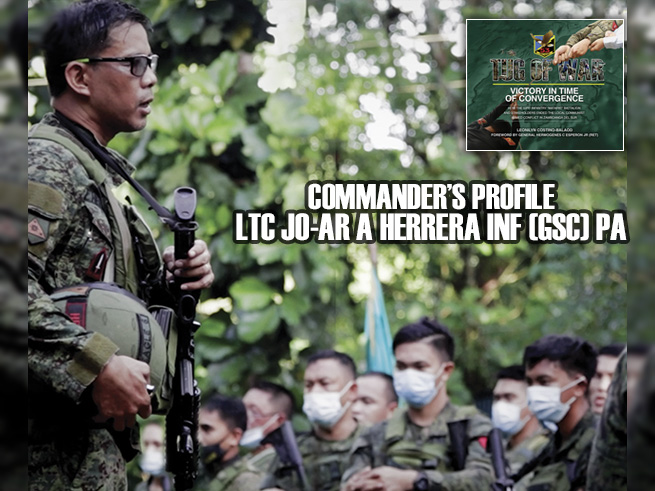
Lieutenant Colonel Jo-ar A. Herrera is the 16th Commanding Officer of the 53IB. He assumed command on March 5, 2020. As the new commander, he raised the bar of leadership high for his staff, his troops, and himself. He knew that the first thing to do was to gain the confidence of his soldiers. Once he had their confidence, he can easily make them follow his lead.
Commanding top performance and expecting accurate results, he can be cruel and unforgiving at mistakes, but he instantly corrects and mentors. He seems to be always on his toes and looking at every situation with eagle’s eyes. Owing to his years of military training and formidable experience, he commands awe and respect. “He leads us by example”; Private First Class Jevelen D. Robledo describes her commander to possess the word of honor. “He does what he says, and we follow him. He goes to the ground, to the farthest trenches, to see his orders are well executed.” For Lieutenant Colonel Herrera, it is walking the talk. He leads from the front instead of pushing his men from behind -sharing the dangers and sacrifices. “If your BatCom orders you to do something, do it right away because it is your commander speaking to you,” echoes Private First Class Robledo. She is motivated to accomplish something every day because, according to her commander, what one achieved yesterday was history. He expects everyone to deliver nothing less than their best daily, just as how he expects it from himself. The speed of the boss is the speed of the team. The commander does not demand from his troops more than what he demands from himself, and for him, it is nothing less than excellence.
Captain Ronald O. Fuentes was the operations officer when Lieutenant Colonel Herrera assumed command of the 53IB. “Lieutenant Colonel Herrera was keen on knowing the enemy and understanding the situation in the AO. He was adamant to see results. It was immediately clear to us that we needed to level up our game,” Captain Fuentes recalled. The pressure instantly went up a notch. He knew that much was expected of him. Captain Fuentes was anxious about his own capability but he was confident of the competence and guidance of his commander. “I knew that he had our back. Lapses in planning and execution can happen anytime. He was stern in dealing with mistakes but the troops were assured that he will stand with his soldiers, “Captain Fuentes went on further.
As the S3, he conceptualized many operations which delivered favorably to the campaign of the battalion. He ascribed the success of the operations to the effort of the entire unit, the effective techniques he learned, and foremost the motivation and support of his commander. “Do we need money? Do we need the local government units? Do we need the priests or do we need God?” recalling the words of his commander. Captain Fuentes knew in his heart that his commander would do everything to get the job done. “He was very decisive and compelling. He is the type of commander that any junior officer would want as a mentor,” he said.
The battalion commander stayed truthful to the apolitical nature of the Army. “The 53IB under Lieutenant Colonel Herrera has many times showed its independence from political influence. They remained non-partisan, and we, as mayors not politically aligned with the governor, can feel their effort to reach out to us,” said Mayor Ruel Molina of Kumalarang. “In all organizations, be it in the local government unit or the Army, the leader sets the tone on how the organization conducts itself. The mayor added that the battalion’s professionalism, which is evident within the organization from the commanding officer down to every soldier, has a huge impact in the campaign to end insurgency in the province,” the mayor added.
Lieutenant Colonel Herrera personally communicates and engages stakeholders and monitors operations. Congressman Leonardo “Jun” Babasa of the 2nd District of ZDS believed that the commanding officer’s engagement with local leaders and directly to the people on the ground also made a difference in the current approach against insurgency. “There is always a system in government or the military, but the plan’s effectiveness depends on how it is executed. It is where leadership plays a determining factor,” the Congressman explained.
The Empathetic Leader
“When Lieutenant Colonel Herrera assumed as battalion commander of the 53IB, it was natural that we had apprehensions. But, he came with a clear vision for the battalion and a clear-cut strategy to end the conflict in the province,” Congresswoman Divina Grace C. Yu declared said. Lieutenant Colonel Herrera had a pocketful of innovative ideas and programs. He introduced a type of leadership that set a new direction for the 53IB and unconventional ways. Since then, the provincial government has strengthened its cooperation with the 53IB even more.
“When Lt. Col. Herrera assumed as Battalion Commander of the 53IB, it was natural that we had apprehensions. But, he came with a clear vision for the 53IB and a clear-cut strategy to end the conflict in the province.”
— Congresswoman Divina Grace C. Yu,
ZDS 1st District
The battalion commander sets high his role as the leader of his organization, in which he plays well. Shifting from what he describes as a “flexible, nonconformist mindset” to an “out-of-the-box attitude,” he championed a type of leadership that conforms to situations rather than traditions. Communicating and teaching the organization’s values to uphold professionalism, promoting and requiring a high level of competence from within the ranks are the core principles of his leadership philosophy. His philosophy speaks of his personality and values, which he shared with the young officers in the battalion. “I only give the vision and philosophy, and my troops translate them into reality,” shared the commander. He encourages them to take pride in what they are doing. He shares the challenges and accolades with them—pushing them not only to win battles but to become excellent military commanders in the future.
What sets Lieutenant Colonel Herrera from his peers is his orientation for development. Mayor Vicente P. Cajeta of Guipos, ZDS described him as a “goal-oriented, outcome-oriented leader.” “He is an achiever. He goes beyond mere compliance with his mission. Still, he initiates laudable programs and takes extra effort to achieve his vision,” the mayor continued.
“Lieutenant Colonel Herrera is a goal-oriented, outcome-oriented leader. He is an achiever. He goes beyond mere compliance with his mission. Still, he initiates laudable programs and takes extra effort to achieve his vision.”
— Mayor Vicente P. Cajeta
Guipos, ZDS
As a leader, he is intentional. Everything he does is tied to his purpose, his master plan. He makes his every action count and follows through with them in a very consistent way. And, he makes sure that his intentions are clear down to the last man in his Army. He not only communicates, but he educates, persuades, and moves his soldiers to action. He jumps at every opportunity to transfer his message to them. Such that his Army resonates with him. So much so that they speak with the same passion and enthusiasm as their commanding officer. “We place even more value on our work. Our commander saw what we are doing, and he recognized our effort,” Private First Class Joven R. Batucan professed. His success in making his troops relate to his purpose results from his sincere and straightforward ability to connect with them. He understands their needs and does not hold back in showing his interest and care for them.
The Competent Manager
“I saw that continuity of vision is significant. That’s why, as much as possible, I attribute whatever accomplishment we have here in the camp to the vision of the former commanders.”
— Lt. Col. Jo-ar A. Herrera
Leaders point out a final goal, while managers lay out the ways to achieve it. The manager focuses on short-term goals, whereas leaders focus on long-term results. The battalion commander places high value as much as he does on being the commander and leader and as a steward of the organization. He takes the high road in managing the system. Effective and efficient allocation of resources for him centers on accomplishing the mission and attaining the desired outcome. He ensures that resources are allocated strategically to sustain the complexity of the operations. Good governance is set by the organization’s managers so that resources are effectively used to meet its needs.
As a good manager, he pursues and improves the vision of the commanders who came before him. “I saw that continuity of vision is significant. That’s why, as much as possible, I attribute whatever accomplishment we have here in the camp to the vision of the former commanders,” the battalion commander explained.
In the same way, he hopes that his successor will continue the vision that he pursued. He has done much to realize the vision through his persistent coordination and facilitation with local government leaders and private stakeholders. He pushed for the concreting of access roads around the camp and the construction of covered courts, serving as the venue for peace-building forums. Improved office facilities, well-conditioned and maintained barracks, upgraded firing range, better-equipped motor pool, water system, and vehicles are among the development projects acquired during his time. His primary motivation as the manager is his soldiers. He wants his troops to be well-accommodated when they come to the battalion, the kind that they do not have in Patrol Bases (PBs). “It is already hard in the detachments; at least when they come here, they will be comfortable,” he mused.
Creating a Champion’s Mindset
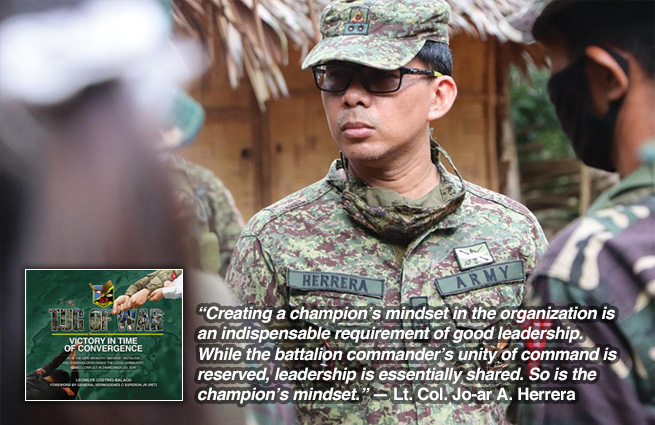
“Creating a champion’s mindset in the organization is an indispensable requirement of good leadership. While the battalion commander’s unity of command is reserved, leadership is essentially shared. So is the champion’s mindset.” — Lt. Col. Jo-ar A. Herrera
“Whether you think you can or you think you can’t, you’re right.” This unsparing truth by Henry Ford, the American Automobile maker, embodies the importance of the right mindset. It is the single most significant factor in success. Lieutenant Colonel Herrera stressed the importance of creating a champion’s mindset among his soldiers. He ensured that they shared the right attitude to propel the unit to victory.
“Every time we have our officers meeting, our battalion commander would talk about the importance of having a champion’s mindset. He sees to it that we are in the same line of thinking. We also do the same for the troops,” First Lieutenant Cernitchez declared. “Having a champion’s mindset means to focus on the objective. It means being consistent and fearlessly persistent in achieving the goal. It’s an unwavering passion for the accomplishment of the mission,” he added.
“The winning mindset, strategic thinking, and command guidance of Brigadier General Leonel M. Nicolas inspired and invigorated the determination of 53IB troops to defeat the CTGs in the Zamboanga Peninsula.”
— Lt. Col. Jo-ar A. Herrera
Second Lieutenant Yu knew what it takes to have that winning attitude. “Champions endure the toil at the present for the pleasure of a future finest result. Having a champion’s mindset is having a winning mentality. It is an intense craving for victory and committing wholeheartedly to the process that would get you there”, Second Lieutenant Yu said.
Captain Cornelio Cortejo thinks that having the champion’s mindset is to continuously improve your work and yourself. He said that “It is striving for excellence in thinking and doing. Not being hesitant to take any challenge and come out better every time.”
For First Lieutenant Mira, a unit with a champion’s mindset is in sync with each other. “We are like a basketball team. We play different positions and roles yet follow a single game plan. We listen to one coach,” he explicated. “In a basketball game, players do not think of their personal achievements or gains. They play for the team to win,” he said. It is precisely how they are in the 53IB. They help each other and work together for the unit’s ends.
Creating a champion’s mindset in the organization is an indispensable requirement of good leadership. While the battalion commander’s unity of command is reserved, leadership is essentially shared. So is the champion’s mindset.
The Foundations of Effective Leadership
“The organization’s efficiency in carrying its mandate relies on effective management of its resources and the consistency of the leadership in reminding its people of their duties.”
— Gov. Victor J. Yu
Governor Victor J. Yu believes that good governance is vital in any organization, like in the local government unit and as much as in the military. “The organization’s efficiency in carrying its mandate relies on effective management of its resources and the consistency of the leadership in reminding its people of their duties,” explained the governor. He quoted from a book that “a good leader is loved by his people; a better leader is feared by his people, but the best leader is both loved and feared.”
Lieutenant Colonel Herrera is both loved and feared. His troops have complete trust in his capability to lead the battalion. His leadership is founded on “Valuing People, Seizing Opportunities, and Organizational Excellence.” The critical step in bringing these ideas to life is creating an efficient chain of command—a team of skilled officers that shares the goals and values of the commanding officer.
The primary function of the chain of command is to flow information rapidly to the trenches so that the commander can adapt and act swiftly to the need on the ground. They serve as the extension of the commander, thinking on their own but acting as he would in their place. They spread the vision for him, keeping the rest of the soldiers in line.
The commander seeks their advice and takes in their excellent ideas. At the same time, he stays clear in retaining ultimate control and preserves the unity of command. Keeping the strings to be pulled at his hands, he ensures that everything starts from the top. What determines failure or success is the style of leadership and the chain of command that the leader designs.
Valuing People:
The Morale Strategies
People are the most important asset of any organization, much more for the Army. Motivated people maintain their morale and think more about the group and less about themselves. Thinking beyond self happens when they feel involved in a cause as an essential element of its success. Morale is contagious, and the people in the organization can get infected without realizing it. It binds and holds the Army to its duty despite any odds, opposing force, or influence.
Lieutenant Colonel Herrera places high value on his troops’ morale and uses his experiences to become an inspirational leader. “I know the feeling of being appreciated especially in front of my peers. Recognition is an affirmation and an assurance that you are doing the right thing” Lieutenant Colonel Herrera stated.
His experiences and innate empathetic nature made him the leader that is both feared and loved by his troops. According to Lieutenant Colonel Herrera, his leadership frame of mind is anchored on the winning mindset, strategic thinking, and command guidance of Brigadier General Leonel M. Nicolas, who inspired and invigorated the determination of 53IB troops to defeat the CTGs in the Zamboanga Peninsula.
The high morale of the troops was evident during the intensity of the campaign when they were relentlessly pursuing the CTGs in the dense and savage terrains in the hinterlands. First Lieutenant Carmen credited the troops’ intrinsic motivation to go after the enemy that brought the CPP-NPA down. “No matter how faultless the mission plan was, we had to trust and rely on the troops’ desire and determination to accomplish the mission,” First Lieutenant Carmen explained. Maintaining the morale of the soldiers was indeed critical in mission accomplishment. It was the fundamental force that drives them to go the extra mile to deliver extraordinary results.
The Power of Recognition:
Presenting Achievement Awards
“It is an affirmation of a good deed, a job well done. It is a culmination of service and loyalty to the mission that seemed unseen for many years.” — CAA Roy Q. Nambling
Catch them doing something right; it makes them want to do better. “I never expected to receive this award, and to have my commander personally it to me is a great honor.” Technical Sergeant Patrick G. Fernandez quipped in an emotional speech during a flag ceremony.
Everyone highly appreciates recognition. “It is an affirmation of a good deed, a job well done. It is a culmination of service and loyalty to the mission that seemed unseen for many years,” said CAFGU Active Auxiliary (CAA) Roy Q. Nambling after receiving his certificate from the commander. He has been in the CAFGU for twenty-eight years. He has silently made a personal history of sacrifices and triumphs with his comrades, which he now proudly narrates with his recognition tucked at his side.
The award adds value to one’s work and his role in the organization. Giving a soldier sincere and meaningful affirmation is the most straightforward way to put him in high morale. A compliment that is shown in public instantly and dramatically increases in value. It builds and motivates the receiver and inspires the spectators. “When you see your fellow soldiers received their awards, you will tell yourself that soon you will also have yours,” Private First Class Marchsteven D. Guigue declared. The troops never realized how this simple act of recognition would touch their hearts and encourage them to do more until they received theirs.
“We are sure we can share birthday celebrations with our family.” — PFC John Carl Sabido
Caring for the Soldiers:
Project Best Life
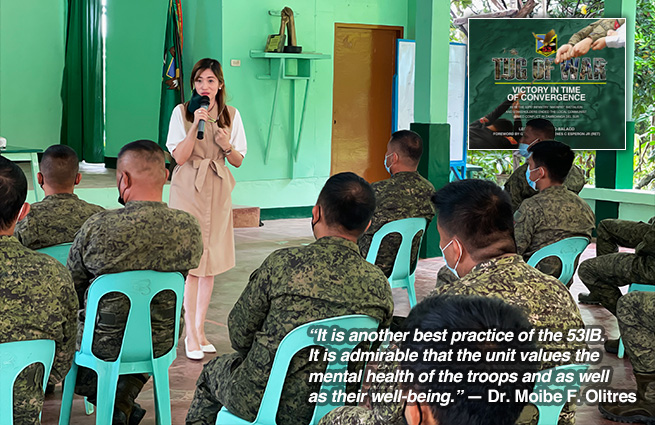
“It is another best practice of the 53IB. It is admirable that the unit values the mental health of the troops and as well as their well-being.”
— Dr. Moibe F. Olitres
Project Best Life for soldiers, CAAs, and their family is an inclusive wellbeing psychoeducation program initiated by 53IB. This program aims to provide a macro-level understanding of the current state of wellbeing of soldiers and on how to address difficulties and improve their mental health and leadership potentials amid a psychologically-challenging career. It provides a venue for counseling and psychoeducation as part of the 53IB’s Mental Health Program following the Philippine Army Mental Health Program (PAMHP).
Captain Cortejo is the lead officer of Project Best Life. He believes in the importance of attending to the psychological needs of the troops especially their relationship with their families. “We can hear news of soldiers involved in an indiscriminate shooting in other units. Unfortunate incidents like that might have been prevented if they had a way to vent their issues and problems. Project Best Life provides a way where the troops and their families can seek support before their problem gets out of hand,” he said.
The program is divided into two phases. Phase 1 involves assessment and psychoeducation of the troops, and Phase 2 caters to the family dependents’ psychoeducation. As Lieutenant Colonel Herrera said, “For the Philippine Army, mental health and wellbeing are essential for soldiery. It’s a way of understanding the soldiers’ potential, the way they use their ability, strengthen their resilience, and cope with the challenges and demands of their military and personal life environments.”
“I could see the eagerness of the participant-troops to share their experiences and their problems during our group sessions. Being able to vent out their emotions is therapeutic in itself,” Dr. Moibe F. Olitres, the mental health consultant of Best Life Project said. “It is another best practice of the 53IB. It is admirable that the unit values the mental health of the troops and as well as their well-being,” she said.
Seizing Opportunities:
Turning Adversities into Advantage
The shared mindset of the officers played a major role in beating their 6-month self-imposed deadline to dismantle the last CTG in their area of operations. Problems happen every time, and everything does not always go as planned. Resources were always scarce, and troops lacked vital combat skills. Obstacles and drawbacks could pile up, and a weak leadership could easily trample at the slightest adversity. It is different for the MATAPAT officers. They see opportunities in hardships, and they turn them to their advantage. Every time they meet a setback, they find a better way of doing things.
The COVID-19 pandemic has shaken the world and disrupted almost all institutions. Everyone was not prepared, and neither had planned for it. The lockdowns happened, and checkpoints were established in every boundary and border. The province was at a standstill. Everything stopped but not the 53IB. They saw opportunities in the turn of events, and instead of slowing down, they added up speed. Despite officers and troops getting infected one after the other, they pushed even more for their goal.
The battalion placed troops in checkpoints to observe compliance with quarantine protocols and monitor the movement of white area supporters of the CTG. They also intensified quarantine restrictions in the barangays to prevent the CTG from getting food and medicines while intensifying offensives against them. The troops relentlessly pursued the CTG. Without food and rest, the enemy eventually disintegrated.
The Calm and Composed Operations Officer
An earnest and unassuming gentleman, First Lieutenant Jonathan C. Cernitchez, serves as the battalion S3. After he graduated from Officer Preparatory Course, Training and Doctrine Command in 2016, he was assigned to the 53IB. He took different assignments before serving as the operations officer. He has always seemed to find himself in challenging situations early on, which honed him for the bigger responsibilities in his career. His experience and accomplishments in leading his troops on the battlefield qualify him to the battalion’s most delicate and taxing position. Foresight, an attitude of safety, and virtuosity are qualities that make him most fitted to his post.
As a leader, he emphasizes balance in giving tasks and expecting compliance and also in his personal and work relationship with his troops. He can be adamant and conscientious, especially during FMO. He expects everyone to work and deliver as planned. But he is also swift to come in aid of his soldiers and takes their safety as his foremost concern. “I would not rest unless I am apprised with their location and situation,” First Lieutenant Cernitchez declared. For him, communication is critical in his work as an operations officer. “I am responsible for the safety of everyone in the battalion, so I need to be on top of everything,” he stressed. He delegates tasks to his Noncommissioned Officers (NCOs), but he expects them to keep him posted on their activities. It gives him peace of mind that everything is working well. “He is very decisive, but still he respects our opinions,” mused Staff Sergeant Ruperto S. Maata as he described his officer. “He is often calm and decisive, which helps when the demands of the tasks are up,” the sergeant added.
First Lieutenant Cernitchez looks at his military service as a privilege and a personal choice, so he feels that he needs to be always in his A-game. However, his love for agriculture and a quiet life with his family is something he is eying for. It could be in the near or distant future; it will surely serve him well. Meanwhile, this ardent officer has his eyes fixed on the mission.
The Passionate CMO Officer
CMO and Information Operations (IO) play a very crucial role in the battalion’s mission. Unique to their strategy is the enormous amount of time and effort they place into community engagements. It is embedded in all the facets of the whole design. CMO and IO activities happen during, after, or even independent of focused military operations. It also takes the lead in the battalion’s sustainment operations. Amidst all these efforts is a brilliant and pleasant officer. The youngest officer in the battle staff, Second Lieutenant George V. Yu Jr., serves as CMO Officer (S7) and Signal Officer (S6) of the battalion.
As a very determined military officer, he is very eloquent and passionate in narrating the message of the battalion to counter enemy propaganda. Time is of the essence for CMO and IO. “We need to be always ahead of the enemy, especially in public information efforts. We cannot let them twist the truth to misinform the people,” the officer explained. He plans, monitors, and even leads community engagement and public information efforts. He maintains and regularly updates the 53IB’s social media pages and the website. The most demanding part of being the CMO and IO officer is the need to be always in the loop on all the activities of the entire battalion. Despite the challenges of his work, he never falters. “I would not want or any parent in the future to worry about their children being lured by the CPP-NPA or vanished because they joined the armed struggle,” he declared.
To his soldiers in CMO, he expects obedience and the same commitment for his work. In CMO, work can sometimes be very demanding, especially now under the guidance of the battalion commander. “Often, there are so many activities going around, and things become very taxing for Second Lieutenant Yu. So, we try as much to assist him,” PFC Jevelen D. Robledo declared. “He also listens to our suggestions, and we have adjusted to his pace. He makes us feel that we have a big part in the success of our activities.”
The young officer has kindled a deep appreciation for his work and his cause. Surprisingly, he found so much fulfillment in his duty for someone who had not thought of becoming a soldier. He believes that being in the Army puts him in a position to do more extraordinary things, which is most important for him.
Life’s circumstances brought him to the academy. The necessity made him prevail over the training challenges and become the up-and-coming officer he is today. It may not be a story of a life-long dream coming true, but indeed it had the most beautiful ending.
Cutting Edge:
The Line Companies
“Everything in war is very simple. But the simplest thing is difficult. These difficulties accumulate and produce friction, which no man can imagine exactly who has not seen war.” — Carl von Clausewitz
On the battlefield, commanders make that their troops do more than survive: They must prevail. The battalion commander’s intent describes the company commander’s duty by getting the job done according to how it was planned and delivering an outcome. But there is so much more. The company functions as a complete administrative and tactical unit. The company commander discharges primary responsibilities of troops’ training, discipline, and providing for personnel’s morale and welfare. Effective leadership is crucial at the company level as it is in the battalion. As the 53IB’s cutting edge, its success is the aggregate of its line companies’ victories in their areas of operations.
Alpha Company Commander:
The Implementer
First Lieutenant Janryl S. Gumalad serves as the company commander of the Alpha Company situated at Barangay Sigapod, Midsalip, ZDS. More than his role as the company’s leader, commander, and manager, he stresses his role as the implementer of the battalion’s intent and guidance. He believes in the unity of command, and he trusts and follows the direction of the battalion commander by heart.
First Lieutenant Gumalad describes his leadership style as participative and transactional. He involves his NCOs in planning. He solicits suggestions and encourages them to speak their mind, although he retains decision-making to himself. He is keen on providing rewards for good behavior and performance with their tasks. He reprimands his troops for mistakes or underperformance. But, he intends to correct the wrongdoing and to give advice.
“Our company commander leads by example and lives by his word,” Technical Sergeant Julius D. Obido declared. He is very persistent during operations. He expects a high standard of discipline among his soldiers and expects every task to be accomplished immediately. He looks after the morale and welfare of his troops. His energetic and bubbly personality and his soft spot for family make him endeared by his troops.
Bravo Company Commander:
The Engager
First Lieutenant Niel Kim M. Garcia is the welfare-oriented company commander of the Bravo Company located in Barangay Upper Landing, Dumingag, ZDS. He relates and looks after his men like his family, especially the senior NCOs whom he bonds with like his older brothers. “But of course, I maintain the professional gap and requires respect as their commander,” the officer mused.
He puts high regard on the soldiers’ ethics and discipline and expects them to treat each other well. He leads a consultative type of management where he acknowledges that he cannot be right at all times. He listens to his troops but ultimately decides by himself, especially concerning operations which he considers the safety of his soldiers as his most tremendous responsibility. He also looks after the company’s amenities, which he considers an essential part of his work. He initiates projects to improve the facilities, so he engages the local chief executives and other stakeholders.
First Lieutenant Garcia allows his NCOs to make recommendations because he acknowledges their experience and knowledge in their tasks. The company’s First Sergeant, Technical Sergeant Bienvenido P. Fernandez Jr., is pleased with the trust and confidence afforded by his company commander. “He gives us, his NCO personnel, room to exercise and develop our leadership which boosts our self-confidence and passion for our work.” First Lieutenant Garcia is, to his men, a very approachable and sympathetic leader, and a persistent and clever commander.
Charlie Company Commander:
The Counselor
First Lieutenant Alvin C. Ibarra is the vicarious company commander of the Charlie Company situated in Barangay Gasa, Lakewood, ZDS. The young commander believes that he needs to know his soldiers well, so he spends time bonding with them. He thinks that their circumstances can affect their performance and their relations in the workplace. “It will create a domino effect. The same thing that failure of the lowest member of the organization ripples to the top of the management,” he said.
First Lieutenant Ibarra supports the battalion commander’s program to take care of the troops’ mental health. He instructs his NCOs to monitor the problems and issues confronting his soldiers so he can promptly respond. He thinks that the leader should also be a counselor. He talks to those who are experiencing marital, family, and financial problems. “You will be moved by the problems that some of my warriors are facing,” the officer expressed. “Most of the time, they only need a listening ear, so I encourage the senior NCOs to talk to them,” he added. To him, the most essential of the company is his soldiers.
Mission accomplishment and high performance will naturally follow when the company’s collective morale is high. “He trusts us to do our work after he gives his guidance, but he ensures that everything gets done. His deeply caring nature and approachable personality make him easy to work with,” said Technical Sergeant Giovanni C. Presno, Charlie Company’s First Sergeant.
Headquarters Company Commander:
The Manager
Captain Michael B. Bumidang has been in the different line companies of the 53IB and did some staff work before assuming as the headquarters company commander. Compared to his previous assignments, his current designation is a little less stressful. As company commander, he oversees the activities and facilities inside the camp. He also monitors the progress of development projects. However, in his current work, one thing he finds challenging is the stakeholder engagement particularly in generating more support for developments in the camp.
He often delegates and supervises his soldiers in his current assignment, although he closely monitors their progress. Whenever he sees future problems or setbacks, he quickly intervenes to assist. He regularly checks on his troops’ morale and initiates activities to motivate them whenever some issues occur. He talks to his soldiers about their work and even personal affairs, and he gives pieces of advice. “He can easily feel if the workload becomes overwhelming; he quickly assists us and divides the tasks to other NCOs. He can feel if someone needs some help with his task, and he quickly comes to assist,” Staff Sergeant Albert M. Caño said. “It is the same for Captain Bumidang whether he is in a good mood or even when upset. He is naturally cordial and soft-spoken,” the sergeant added.
Organizational Excellence:
Sustaining the Vision
The excellent organization sustains its outstanding achievements. The 53IB engenders a transformational framework for organizational excellence: visionary leadership, strategy, people, resources, and stakeholder engagement.
An organization needs a leader who has a clear picture of the future and molds the organization to achieve the vision. Lieutenant Colonel Herrera provided the vision for the battalion, and he trained his officers to be the agents for change. They communicate the vision, inspire, and motivate their people. They developed the most effective strategy and plan of action. Then they rallied their troops behind the goal. He trained them to improve their knowledge, skills, and capabilities. Recognized, rewarded, and cared for their needs, so they become more committed to the goals and values of the organization. They efficiently managed and maximized the utilization of resources to support the strategy. They established cooperation with the local leaders and communities to further their mission. Military officers can come and go as they progress in their career; only by attaining excellence can the battalion sustain its high achievements despite leadership changes.
The Proactive Logistics
and Training Officer
Human and material resources are the lifeblood of any organization, and it enables the battalion to sustain its strategy. Without effective resource management, the 53IB cannot achieve organizational excellence. First Lieutenant Jerick Christian N. Papa zealously performs duties involving planning and budgeting for the battalion’s resource allocation. Planning and budgeting are the basis of the battalion’s ability to support its activities and, therefore, its success. In preparing the budget, he also identifies the training needs of the troops in the battalion. “It’s important to foresee what skills and capabilities the troops will need, so we base it on what is the evolving situation on the ground.” explained the young officer. “In planning, we should be proactive and should not wait for problems to happen before we plan a course of action,” he added. He is idealistic and straightforward.
As logistics manager, he ensures that supplies and equipment are well-maintained and readily available anytime to support the administrative and operational activities. “I do not micro-manage, but as much as I can, I micro-supervise,” he explained to describe his management style. In micro-supervising, he gives his troops a leeway to perform their tasks as long as they can deliver. He is confident with the ability of his NCOs to comply with the tasks assigned. What gets to his nerves is when his soldiers do not comply or delay compliance, but he shows them how to do the task if they lack knowledge or skill. He considers himself strict and rough when it comes to underperformance. Still, he also listens and even solicits suggestions from his troops. “He is outraged, especially when we do not meet the compliances, but he does not hold a grudge. We understand because he immediately explains the reason why he lost his cool. He reminds us to do better in our tasks,” Staff Sergeant Eduardo R. Roxas expressed.
Sergeant Major:
The Motivator
“I always try to be discerning in giving reprimand or punishment so they would not repeat the wrong behavior but always commensurate to their violation.” — MSgt. Vicente A. Mayo
Master Sergeant Vicente A. Mayo describes his position as the voice of the enlisted personnel in terms of morale, welfare, and discipline to the battalion commander. He also relays the guidance and the intent of the battalion commander to the troops. He monitors the needs and issues of the personnel so he can represent them to the commander and the staff. He addresses the soldiers’ personal and work-related conflicts to help them and advise them on the best option available for them. It helps that the sergeant major has a naturally caring personality. However, his duties would sometimes require him to be tough and decisive especially involving personnel discipline. “I always try to be discerning in giving reprimand or punishment so they would not repeat the wrong behavior but always commensurate to their violation.” Sergeant Major Mayo explained.
Another role that he attributes high value is being the motivator of the troops. During small unit leadership development training, he shares his experiences with the troops. He explains the purpose of their efforts and instigates them to commit to the intent of the battalion commander. He believes in the importance of this work in accomplishing the 53IB’s vision, so he does his best to perform his task well.
Obliging Executive Officer:
The Peace Maker
Captain Bahnarin K. Camsa, as Executive Officer (Ex-O) of the battalion, describes his position as the “hammer.” He coordinates with the staff and supervises all the administrative activities of the 53IB to ensure that all systems are running according to the intent of the battalion commander. The officer believes an effective Ex-O must tailor his leadership to that of his commander. He considers himself as the “pep talker.” Given the leadership style of the battalion commander, “I tend to go-between the commander and the staff, and I will find ways to appease the staff officers if the tension and stress get so high,” said Captain Camsa. “But I always make sure that everything gets done as programmed.” The Ex-O updates the commander on the status of the activities reports problems and makes sure that he has also prepared his recommendation.
As for his troops, he treats them like family. He agrees and supports the battalion commander in valuing the people and recognizing their contribution to the unit’s success. He takes care of his soldiers and bonds with them while striving to deliver the battalion commander‘s intent.
When he came to the 53IB in 2020, he had a vital mission. He was ordered to engage the Moro communities in the province. Before that time, a kidnapping happened, and the hijacking of fishing boats by pirates was common. Being a Moro, a Maguindanaoan, himself is his advantage, but it was not also an easy task. His greatest challenge was overcoming the indifference of the Moro people to the military. Their distrust for the military, which originated from Martial Law abuses, was the biggest obstacle. He went to these far-flung, impoverished communities to open a dialogue with their leaders. He did not expect trust and friendship to grow quickly between him and the people. Still, he had been very persistent and sincere in his intention to win the hearts of the Moro communities.
He knew that he needed to help them first, sow seeds of good intention, so he engaged the provincial government and the local officials to develop those areas. He urged them to provide for the needs of those communities. They also included the young Moros in the Youth Leadership Summit for them to experience the new brand of the Army, which is the total opposite of how their elders told them. He would rather talk about peace and development than bring war to the people. “I don’t believe that gunfight will end the war, be it with the CPP-NPA or the Moro extremists and terrorists,” the Captain exclaimed. He does not treat the CTG nor the lawless groups’ sympathizers as enemies but instead looks at them as victims of wrong ideology. He believes in dialogue, diplomacy, development, and cultural sensitivity as the prime movers of peace.
Encapsulation
Leading with a heart is leading with compassion, empathy, and care. A heart that deeply cares for the soldiers, community, stakeholders and even the enemy defined the leadership of the battalion.” — Lieutenant Colonel Jo-ar A. Herrera
The administration of Lieutenant Colonel Herrera played a crucial part in the battalion’s success. Firstly, he set the bar of excellence high for everyone, including himself. He set the tone on how 53IB should perform. He had a clear vision and a consistent message. Mistakes were avoided because there was no second-guessing of the commander’s intent. His leadership is characterized by fluidity – the ability to respond immediately to the needs and demands of every situation but without going off the strategy and the mission plan.
Secondly, he created leaders among his troops. He knew that he needed to amplify his vision and his entire organization’s direction, but he could not do it alone. “Military leaders are made in the harshest conditions. Pressure is needed to turn coal into a diamond,” as he always said. The battalion commander never held back in pushing his officers and soldiers to their fullest potential. He transformed his troops to share his values, goals, and attitude and act like he would in critical situations. He not only made them be his best subordinate leaders, but he prepared them to be the next great military officers they were meant to be.
Thirdly, keeping the soldiers’ morale high was most critical in ensuring the battalion’s high standard of accomplishment. The organization could have easily given in to the pressure if they did not feel valued and cared for by the leadership. Living up to the call of duty is very demanding, but making each soldier feel that he is doing excellent service and recognizing his contribution to the mission was a game-changer for the battalion leadership.
Finally, they continued to develop and improve as an organization. They trained their troops and provided them with skills that equipped them in the battleground and boosted their confidence in their ability to take down the enemy.
It indeed took excellent leadership to achieve organizational excellence that propelled the battalion to its success. What sets the 53IB leadership apart from among its peers is the heart. Leading with a heart is leading with compassion, empathy, and care. A heart that deeply cares for the soldiers, community, stakeholders, and even the enemy defined the leadership of the battalion.
Author’s Note
“It is the set of the sail and not the gale that determines the way it goes.” This is my favorite saying which I had written in all my graduation yearbooks. This is precisely how I view my life. I am my own leader; my mind is. I set my goals regardless of where the wind blows. Challenges in life may delay the journey but it should not derail us from the destination. If it will take us longer to get there, it doesn’t mean we have failed. The direction we are taking is far more important than our speed.
The lesson of the 53IB experience is that an organization is only limited by its leader’s abilities. The commander significantly defines what the 53IB can achieve. He determines the pace and the attitude of the battalion. The 53IB rose above its peers because they were willing to do more than what was usual. They went beyond their comfort zones and conquered their limitations. It is the influence of leadership that the best leader can bring into the organization.
And so, we are. We are only limited by what our minds can conceive. The greatest battles in our lives are mostly waged inside our minds. We are rational beings. We sustain our rationality in times when we are in control but in the face of chaos, we often let our emotions dictate our behavior. Understand that our mind is weaker than our emotions. We should pay attention to those emotions that affect our choices. Our awareness of our emotions decreases our chances to make irrational decisions. We should never allow our emotions to overpower our intelligence.
Thus, we need to train our minds to become the leader that will bring us to win in life. We can only do it by taking risks. When we are anxious, we tend to avoid the edge but we must keep our minds moving. Only when we are faced with adversities that we discover and conquer our weaknesses. When we are tired, sometimes it is just because we are bored. We are bored when there is no real challenge that faces us because we only have taken on less than what we are capable of. Often what we need is to leave the shores, enter new waters, and learn to ride the tides. This is the only way that we become our strongest selves.